
Ferula gummosa
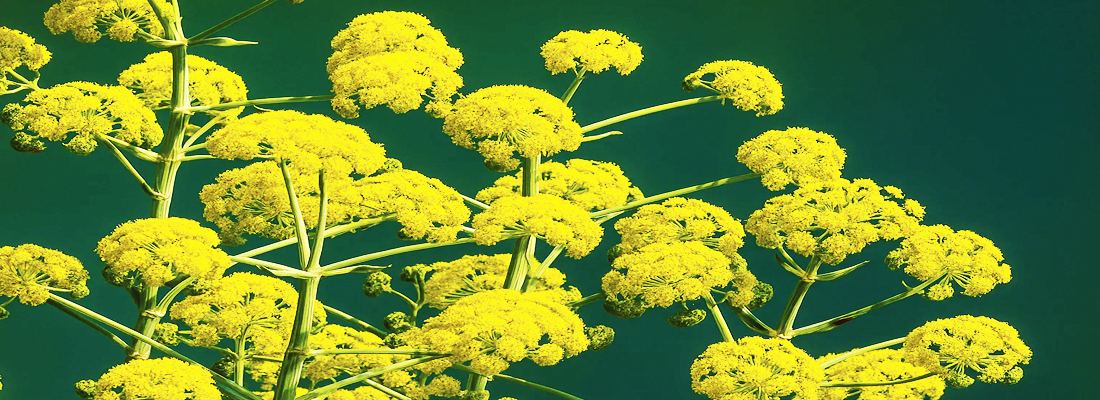
Ferula, derived from the Latin term 'ferula' meaning 'rod', is a genus including approximately 220 species of flowering plants within the Apiaceae family, indigenous to the Mediterranean region extending to central Asia, predominantly growing in arid climates. The genus Ferula comprises 133 species of perennial plants within the tribe Peucedaneae, subfamily Apioideae, and family Umbelliferae, which are found in the wild in the Mediterranean region and Central Asia.
Ferula gummosa is a perennial monocarpic species. The root is cylindrical, robust, and can attain a length of up to 1.5 m, with a diameter of 15-20 (30) cm. Stems are upright, measuring 1.0-1.5 m in height, slightly hollow, and branching at the apex, typically producing one (sometimes 2-3) generative twigs, flowering and fertilizing once every 7-9 years. The leaves are soft and quickly deteriorating; the upper surface is glabrous, while the lower surface is somewhat pubescent. The leaves at the root collar are short with robust petioles, and the leaves along the stem are diminutive and exhibit a groove. The leaves exhibit a pyramidal structure, with the leaf blade divided twice. The segments are lanceolate, featuring flat margins, measuring 14.0-18.0 cm in length and 5.0-7.0 cm in width[1].
Ferula gummosa is a monocarpic, perennial herbaceous wild plant, measuring 0.8 to 3 meters in height, native to Iran, and found in the northern and western regions of the nation at elevations over 2000 meters. It is a resinous plant characterized by a pungent odor. Galbanum derived from Ferula gummosa is recognized for its bioactive qualities, including antimicrobial, antiseptic, analgesic, and antidiabetic effects, among various other medical uses[2, 3].
Ferula gummosa, an oleo-gum resin, is referred to as "Galbanharz" in German, "حلبينة" in Arabic, and "gálbano" in Spanish.
In Eastern traditional medicine, galbanum is frequently utilized for the treatment of convulsions, neurological problems, diabetes, joint discomfort, and inflammation. This plant has been reported to exhibit several biological properties, including cardioprotective, antibacterial, antioxidant, and spasmolytic effects. The principal constituents of galbanum essential oil are β-pinene (10-50%) and α-pinene (5-30%). Additional significant chemicals comprise fenchyl acetate, β-eudesmol, α-eudesmol, bulnesol, α-bisabolol, and guaiol (3-6%)[4-6].
**Disclaimer: This content is for informational purposes only. It is not intended to provide medical advice or to replace advice or treatment from a qualified healthcare professional
References
1- F. U. Mustafina, H. Lee, V. K. Sharipova, A. Lee, D. W. Kim, M. N. Choi, J. W. Jang and Y.-S. Kim, Flora 2021, 283, 151899.
2- A. Maroyi, Journal of Pharmaceutical Sciences and Research 2019, 11, 3661.
3- H.-R. Adhami, V. Fitz, A. Lubich, H. Kaehlig, M. Zehl and L. Krenn, Phytochemistry Letters 2014, 10, lxxxii.
4- H. T. Jalali, S. Petronilho, J. J. Villaverde, M. A. Coimbra, M. R. M. Domingues, Z. J. Ebrahimian, A. J. Silvestre and S. M. Rocha, Industrial crops and Products 2013, 44, 185.
5- A. S. Najafabadi, M. R. Naghavi, H. Farahmand, A. Abbasi and N. Yazdanfar, Journal of Essential Oil Bearing Plants 2017, 20, 282.
6- N. Miyazawa, A. Nakanishi, N. Tomita, Y. Ohkubo, T. Maeda and A. Fujita, Journal of agricultural and food chemistry 2009, 57, 1433.
