
Rosmarinus officinalis
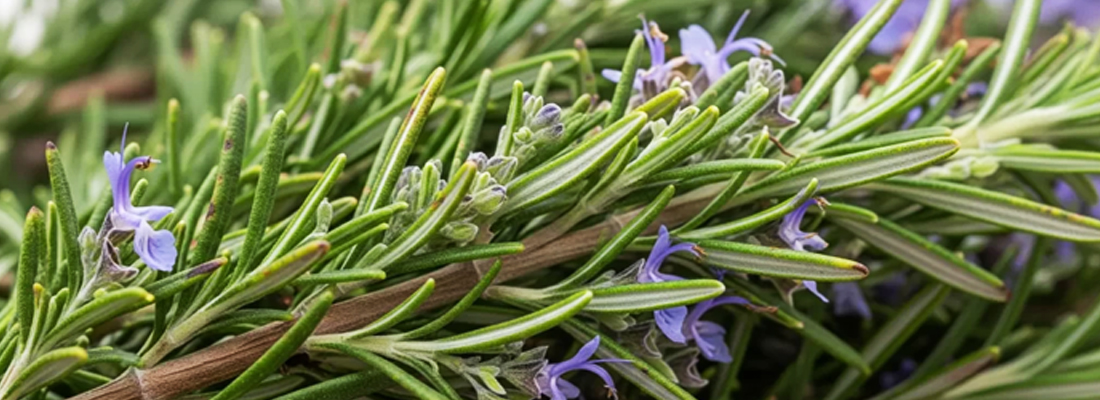
Rosemary is a member of the Lamiaceae family, one of the largest and most notable families of flowering plants, comprising approximately 236 genera and 6900–7200 species globally.
Rosemary is a thick, branching, evergreen shrub with blue-white flowers, reaching a height of approximately 1 meter. It is characterized by leaves of 1–4 cm in length and 2–4 mm in width, sessile, leathery, linear to linear-lanceolate, with curved margins, a dark green upper surface, a granular and pale underside, a strong midrib, and a distinctive aroma[1].
Rosmarinus officinalis is utilized as a tincture or tea derived from the aerial parts of the plant for the management of gastrointestinal illnesses, as well as pain and inflammation-related ailments. employed in the management of dyspepsia and less severe types of spasmodic gastrointestinal problems, circulatory irregularities, as an adjunct in the alleviation of muscle or joint pain, and inflammatory conditions[2].
In Traditional Persian Medicine, rosemary has been utilized in folk medicine to mitigate several ailments, including headaches, dysmenorrhea, stomachaches, epilepsy, rheumatic pain, spasms, nervous agitation, memory enhancement, hysteria, sadness, and both physical and mental tiredness[3].
The essential oil of rosemary, extracted via steam distillation from the leaves (up to 2.5%), is colorless to light yellow, water-insoluble, and possesses a distinctive camphoraceous scent. The primary components of rosemary essential oil are camphor, 1,8-cineole, α-pinene, borneol, camphene, β-pinene, and limonene, with their quantities fluctuating based on the vegetative stage and bioclimatic circumstances[4-6].
**Disclaimer: This content is for informational purposes only and is not intended to provide medical advice, diagnosis, or treatment. Please consult a qualified healthcare professional for personalized guidance.
Rosmarinus officinalis essential oils chemical composition (%) from four different regions*.
|
|
African |
Mediterranean |
East Asia |
Middle East |
|
α-Pinene |
30-50 |
Up to 30 |
Up to 30 |
Up to 15 |
|
Camphene |
Up to 5 |
5-10 |
1-5 |
Up to 5 |
|
Limonene |
1-3 |
0.5-1 |
- |
1-3 |
|
1,8-Cineole |
Up to 20 |
Up to 20 |
10-30 |
5-10 |
|
Camphor |
Up to 3 |
10-20 |
1-5 |
5-10 |
|
Verbenone |
10-12 |
1-5 |
10-15 |
Up to 5 |
|
Caryophyllene |
1-3 |
1-5 |
1-2 |
1-5 |
* Main Rosmarinus officinalis essential oil metabolites profile based on USP monograph:
α-pinene (20.1-21.7%), β-pinene; camphene; limonene; 1,8-cineole (23.5-26.5%); eucalyptol (4.5%); and borneol - camphor (7.2%); berbonone (7.6%); linalool; verbenol; terpineol; 3-octanone; isobornyl acetate.
References
1- R. D. Bidgoli, Advancement in Medicinal Plant Research 2018, 6, 40.
2- J. M. Andrade, C. Faustino, C. Garcia, D. Ladeiras, C. P. Reis and P. Rijo, Future science OA 2018, 4, FSO283.
3- F. J. González-Minero, L. Bravo-Díaz and A. Ayala-Gómez, Cosmetics 2020, 7, 77.
4- F. Serralutzu, A. Stangoni, B. Amadou, D. Tijan, G. A. Re, S. Marceddu, A. Dore and S. Bullitta, Genetic Resources and Crop Evolution 2020, 67, 1777.
5- W. Wang, N. Wu, Y. Zu and Y. Fu, Food Chemistry 2008, 108, 1019.
6- W. Wang, N. Li, M. Luo, Y. Zu and T. Efferth, Molecules 2012, 17, 2704.
