
Myrtus communis
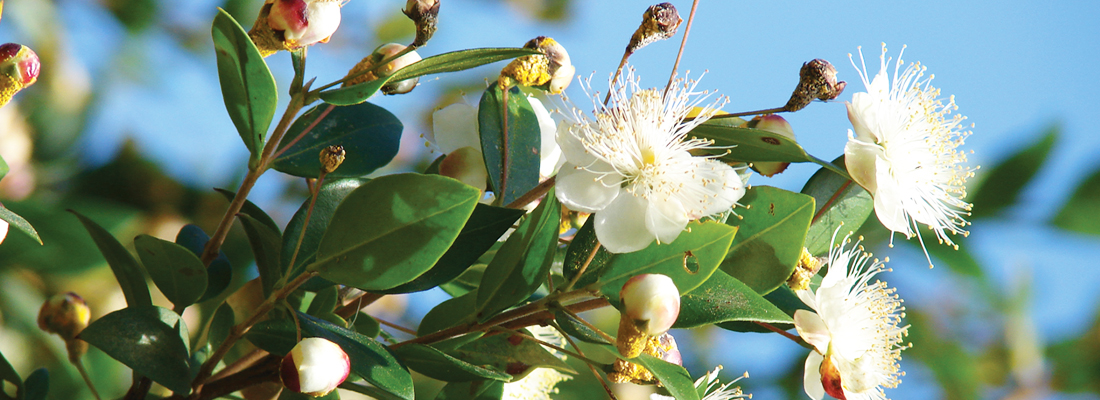
Myrtus communis, or common myrtle, is a flowering plant from the Myrtaceae family. It is endemic to southern Europe, North Africa, Western Asia, the Mediterranean, and India. From the Latin myrtus, from the Greek myrtos, which comes from the same source as myron and meaning "scented essence".
Myrtus communis is a tiny evergreen shrub with an open habit and dense, brilliant green leaves. It develops slowly but can last for generations. When the tree is young, its reddish-grey bark peels off in elongated plates. The lustrous, leathery leaves are arranged to create a stunning, compact crown. They are elongated, with a very acute apex and a full border, and have a single conspicuous vein; the underside is lighter. The phyllotaxis is the reverse, with each pair of leaflets staggered 90 degrees to maximize sunshine exposure. The single, axillary blooms are long-stalked, fragrant, and white or pink[1]. They feature radial symmetry and varying numbers of petals. The flower's long, numerous stamens give it a vapourous aspect. Flowering occurs between May and June. The fruits are ellipsoid berries in black, blue, or reddish-purple that, if not plucked, remain on the plant for a long time and are highly beautiful.
For thousands of years, humans have prized all parts of the myrtle plant. In addition to the well-known liqueur created from its berries or leaves, the essential oil collected from the branches, leaves, flowers, and fruits is used in fragrances, soaps, deodorants, and cosmetic products. Its active constituents include chemicals with balsamic and antibacterial qualities. Also used as a flavoring agent.
Myrtle is used in traditional medicine to treat a wide range of illnesses, including gastrointestinal difficulties such as diarrhea and ulcers, inflammation, and skin and respiratory diseases. It is used to treat hemorrhoids, improve wound healing, and acts as an astringent, antibacterial, and disinfectant[2].
Although the volume and content of essential oils vary depending on myrtle ecotypes, geographical location, and extraction methods, The essential oils contained α-pinene (20-30%), 1,8-cineole (15-25%), linalool, geranyl acetate, and limonene (17-25%) in leaves and berries. Other minor components were α-terpineol, linalyl acetate, α-humulene, p-cymene, and geraniol[3-5].
**Disclaimer: This content is for informational purposes only. It is not intended to provide medical advice or to replace advice or treatment from a qualified healthcare professional.
Myrtus communis essential oils chemical composition (%) from different regions.
|
|
Italy |
West Asia |
Our sample |
|
|
1,8-cineole |
7-20 |
7-20 |
10-15 |
|
|
α-Pinene |
50-70 |
Up to 25 |
20-26 |
|
|
β-Pinene |
2-5 |
Up to 0.5 |
trace |
|
|
Limonene |
20-30 |
Trace-20 |
trace |
|
|
Geranyl acetate |
1-2 |
2-5 |
Up to 2 |
|
|
α-terpineol |
2-8 |
Up to 7 |
trace |
|
|
p-cymene |
05-1 |
- |
- |
|
|
Linalool |
Up to 10 |
5-15 |
Up to 10 |
|
References
1- Y. Cheryatova, in 'Morphological and Anatomical Study of Medicinal Plant Material Myrtus communis L', Springer, 2022.
2- G. Alipour, S. Dashti and H. Hosseinzadeh, Phytotherapy research 2014, 28, 1125.
3- A. Hennia, S. Nemmiche, S. Dandlen and M. G. Miguel, Journal of essential oil research 2019, 31, 487.
4- A. Bouzabata, C. Cabral, M. J. Gonçalves, M. T. Cruz, A. Bighelli, C. Cavaleiro, J. Casanova, F. Tomi and L. Salgueiro, Food and Chemical Toxicology 2015, 75, 166.
5- J.-C. Chalchat, R.-P. Garry and A. Michet, Journal of essential oil research 1998, 10, 613.
