
Pelargonium graveolens
Pelargonium, the largest genus within the Geraniaceae family, comprises 270 species along with numerous cultivars and hybrids. This genus is indigenous to southern Africa and Australia; however, many species are cultivated in Europe, North America, and Asia.
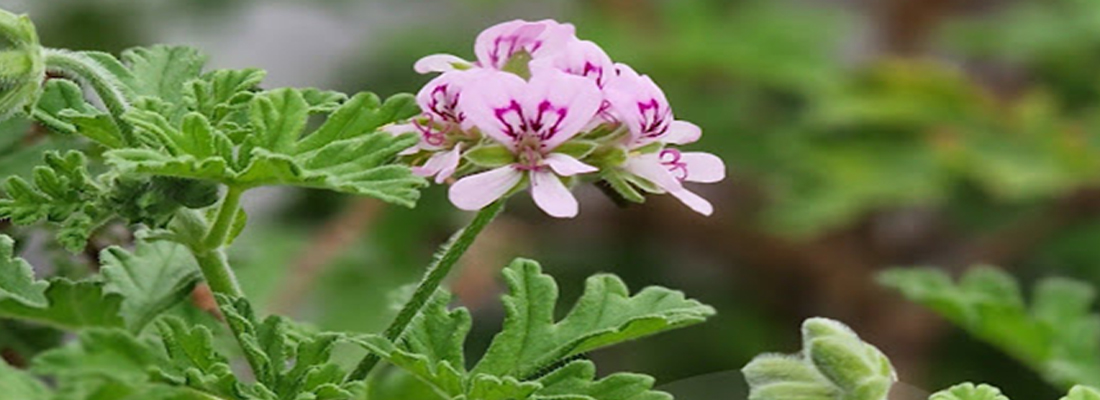
Pelargonium graveolens is a multibranched, erect, aromatic subshrub that attains a height of 1.5 meters and a width of 1 meter. The leaves are silky, soft on the touch, and deeply divided due to glandular hairs. The plant's above-ground components are predominantly glandular and pubescent. Petioles and leaf blades are detached from the alternately arranged leaves. The leaf blade is obtuse, cordate, palmately cleft, and features lobes that are either lobed or coarsely serrated. The organic form possesses a minty aroma. The morphology and fragrance of the leaves differ among cultivars; some have an aroma like rose petals, whereas others possess minimal to no scent[1].
Pelargonium graveolens, known as "sweet - scented geranium" in English, "Pélargonium À Forte Odeur" in French, "Rozenpelargonium" in German, and "kiouli" in Greek.
Historically utilized in the Balkan region as a flavoring component in many beverages. Traditionally, it is extensively utilized for the treatment of different issues, including dysentery, hemorrhoids, inflammation, excessive menstrual bleeding, and skincare[2].
The most common chemicals in all geographical regions are citronellol (20-30%) and geraniol (20-25%). In the next level, 2-Phenyl ethyl tiglate and Geranyl tiglate. Notable variations were identified in minor compounds, including epi-α-Cadinol, γ-Eudesmol, viridiflore, and γ-Gurjunene[3-5].
**Disclaimer: This content is for informational purposes only. It is not intended to provide medical advice or to replace consultation with a qualified healthcare professional.
Pelargonium graveolens essential oils chemical composition (%) from three different regions:
|
|
Balkan |
West Asia |
North Africa |
|
Geraniol |
20-27 |
20-27 |
Up to 8 |
|
Citronellol |
10-15 |
20-25 |
15-20 |
|
Menthone |
2-5 |
trace |
trace |
|
6,9-Guaiadiene |
2-5 |
Up to 0.5 |
0.1-0.5 |
|
2-Phenyl ethyl tiglate |
Up to 2 |
Up to2 |
- |
|
10-epi-γ-Eudesmol |
Up to 5 |
trace |
5-10 |
|
Epi-α-Cadinol |
05-1 |
trace |
trace |
|
Citronellyl formate |
trace |
Up to 10 |
Up to 10 |
|
Geranyl formate |
- |
1-4 |
Up to 5 |
|
Geranyl tiglate |
1-4 |
0.5-2 |
1-3 |
|
γ-Eudesmol |
trace |
Up to 8 |
trace |
|
Germacrene D |
trace |
Up to 1 |
2-4 |
References
1- Boukhris, M., et al., Trichomes morphology, structure and essential oils of Pelargonium graveolens L’Hér.(Geraniaceae). Industrial crops and products, 2013. 50: p. 604-610.
2- Galea, C., Perspectives on the use of geranium essential oil: Pelargonium graveolens and pelargonium roseum, in dental medicine. Rom. J. Med. Dent. Educ., 2023. 12(2).
3- Kačániová, M., et al., An in-depth study on the chemical composition and biological effects of Pelargonium graveolens essential oil. Foods, 2023. 13(1): p. 33.
4- Van der Walt, J. and F. Demarne, Pelargonium graveolens and P. radens: A comparison of their morphology and essential oils. South African Journal of Botany, 1988. 54(6): p. 617-622.
5- Hsouna, A.B. and N. Hamdi, Phytochemical composition and antimicrobial activities of the essential oils and organic extracts from Pelargonium graveolens growing in Tunisia. Lipids in health and disease, 2012. 11(1): p. 167.
