
Citrus x aurantium
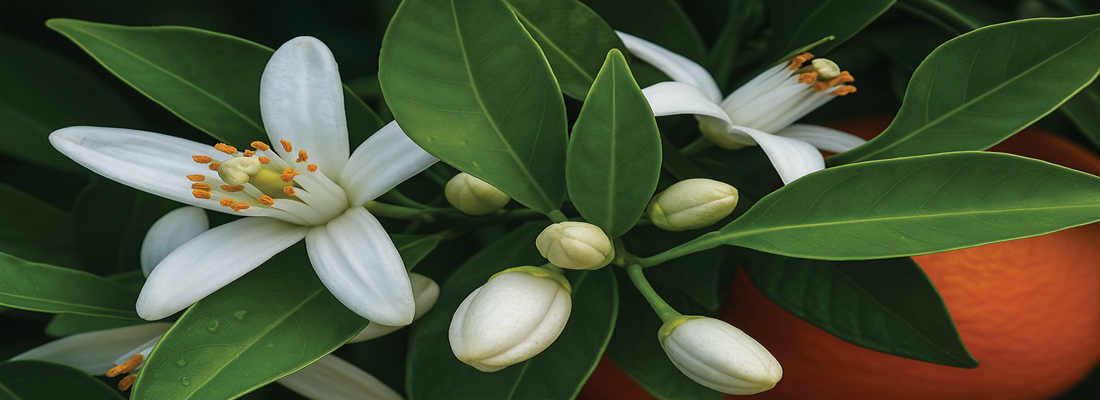
The Citrus aurantium (bitter orange) is evergreen tree with a rounded crown, growing up to 10 meters. It has glossy, ovate leaves with crenate borders, aromatic properties, and winged petioles, along with a thorny structure with thick or thin spines. Its flowers have complete structures, white, and very fragrant, a globose or spheroid hesperidium fruit with thick, rough, fragrant, and slightly wrinkled orange skin.
As a stimulant and appetite suppressant, bitter orange has long been used to treat digestive issues including nausea and indigestion as well as to alleviate anxiety and sleeplessness Hydrosol of orange flower was used to treat scurvy, fever and in cases of an enlarged spleen. Many traditional references also exist for the application of orange flower hydrosol in nervous and hysterical disorders due to anti-anxieties’ properties. Also used in the cachexia recovery associated with chronic illness and intermittent fever.
Bitter orange flowers are used in TPM as a hydrosol to assist the neurological system, namely for neuroprotective and antidepressant properties. It is also said to have aphrodisiac and liver-supporting qualities. Furthermore, bitter orange flower hydrosol is utilized to treat bloating, dyspepsia, diarrhea, and polymenorrhea[1]. Bitter orange is traditionally used to treat digestive disorders such as nausea and indigestion, as a stimulant and appetite suppressant, and for its effects on sleeplessness and anxiety.
Also is a classic herb in traditional Chinese medicine for regulating Qi (气), with its use reaching back to the 2nd century CE, when it was first listed in Classic of the Materia Medica (the Shennong Bencaojing 神農本草經), Its principal traditional therapeutic remedy is to relieve Qi stagnation in the belly and chest, with a focus on digestive pain. According to the Great Pharmacopoeia, a 16th century TCM source, " Bitter orange can chase out accumulated food, eliminate phlegm, and clear through constipation"[2].
The main ester of neroli oil is linalyl acetate (2-15%) followed by geranyl acetate (about 3%) and neryl acetate (about 1.5%). The most abundant monoterpene hydrocarbon is limonene (8-12%) followed by β-ocimene (3-5%), and by β-pinene (2-4%); the main sesquiterpene hydrocarbon is β-caryophyllene (0.6-0.9%)[3-5].
**Disclaimer: This content is for informational purposes only. It is not intended to provide medical advice or to replace advice or treatment from a qualified healthcare professional.
Citrus × aurantium essential oils chemical composition (%) from three different regions.
|
|
Italian |
Egyptian |
Middle East |
|
|
Linalool |
Up to 40 |
40-60 |
10-20 |
|
|
Limonene |
6-11 |
Up to 10 |
1-3 |
|
|
β-Pinene |
1-3 |
1-3 |
trace |
|
|
Myrcene |
Up to 1 |
1-3 |
1-3 |
|
|
β-ocimene |
3-5 |
3-5 |
2-4 |
|
|
α-terpineol |
3-6 |
Up to 4 |
Up to 4 |
|
|
Nerol |
Up to 0.5 |
1-2 |
1-3 |
|
|
Linalyl acetate |
Up to 2 |
3-5 |
0.5-3 |
|
References
1- V. Karthikeyan and J. Karthikeyan, International journal of drug discovery and herbal research 2014, 4, 766.
2- M. Namazi, S. A. A. Akbari, F. Mojab, A. Talebi, H. A. Majd and S. Jannesari, Iranian journal of pharmaceutical research: IJPR 2014, 13, 1011.
3- G. Dugo, I. Bonaccorsi, D. Sciarrone, R. Costa, P. Dugo, L. Mondello, L. Santi and H. A. Fakhry, Journal of essential oil research 2011, 23, 45.
4- K. A. Khalid, Journal of Essential Oil Bearing Plants 2022, 25, 208.
5- A. Mohagheghniapour, M. J. Saharkhiz, M. T. Golmakani and M. Niakousari, Sustainable Chemistry and Pharmacy 2018, 10, 118.
