
Rosa × damascena
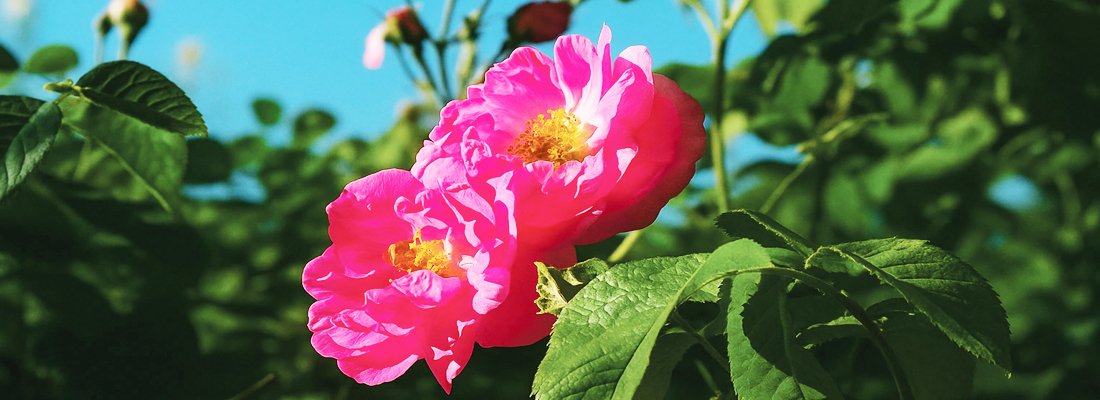
Rosa damascena is a deciduous shrub with upright stems that can grow up to 2 meters tall and are thickly loaded with curved prickles and stiff bristles. It has pinnate leaves with five to seven oval leaflets that are dull on top but hairy below. The flowers are semi-double and have light to medium pink or crimson petals. The dried buds are pink or light-pink, with light-green sepals and a pale-green receptacle. They're broad and inverted-ovate, with a notch at the apex and a narrow base. The dry buds range in length from 2.5 to 3.5 cm. Five ovate sepals, strongly pinnate and pubescent. They have glandular and hairy backs that become aggressively reflexed during blossoming[1].
The Damask rose originated in the Middle East, and some evidence suggests that rose water originated in Persia, but the aromatic oil and extracts originated in Greece. The plant is grown all over the world, including Iran, Europe, Bulgaria, Turkey, and India.
It is one of the most important species in the Rosaceae family. Rosaceae are well-known ornamental plants, sometimes referred to as the "king of flowers." Currently, approximately 200 rose species and more than 18000 varieties of the plant have been discovered. Aside from its use as decorative plants in parks, gardens, and homes, Rosa damascena is mostly grown for use in perfume, medicine, and the food sector. However, Rosa damascena is well known for its perfuming properties. Rose water was strewn at weddings to ensure a happy marriage and is a sign of love and purity. It is also used to aid in meditation and prayer.
Rosa damascena 's greatest beneficial effects in ancient medicine were the treatment of abdominal and chest pain, strengthening the heart, treating menstrual bleeding and digestive disorders, and reducing inflammation, particularly in the neck. North American Indian tribes utilized a decoction of the root of the Rosa damascena plant to treat children's coughs. This herb also serves as a mild laxative. Rose oil alleviates depression, bereavement, nervous stress, and tension. It aids in the reduction of thirst, the healing of old caugh, the treatment of female-specific symptoms, wound healing, and skin health. Rose oil vapor therapy can aid allergies, headaches, and migraines[2, 3].
Damask rose essential oil mostly contains β-citronellol (10-40%), nonadecane (10-40%), geraniol (5-15%), and henicosane (7-15%). Other important compounds include geraniol, β-phenylethyl benzoate, and phenyl ethyl alcohol[4-6].
**Disclaimer: This content is for informational purposes only and is not intended to provide medical advice, diagnosis, or treatment. Please consult a qualified healthcare professional for personalized guidance.
Rosa × damascene essential oils chemical composition (%) from two different regions.
|
|
Mediterranean |
Middle East |
|
Citronellol |
Up to 40 |
40-60 |
|
Nonadecane |
6-11 |
Up to 10 |
|
Geraniol |
1-2 |
1-2 |
|
β-phenylethyl benzoate |
Up to 0.5 |
0.2-0.8 |
|
Phenyl ethyl alcohol |
0.2-0.5 |
0.2-0.5 |
|
Linalool |
0.2-0.5 |
Up to 0.2 |
|
Heneicosane |
Up to 15 |
10-20 |
|
Nonadecane |
Up to 15 |
10-20 |
References
1- A. Khaleghi and A. Khadivi, Genetic Resources and Crop Evolution 2020, 67, 1981.
2- N. Nayebi, N. Khalili, M. Kamalinejad and M. Emtiazy, Complementary therapies in medicine 2017, 34, 129.
3- F. Afsari Sardari, G. Mosleh, A. Azadi and A. Mohagheghzadeh, Research Journal of Pharmacognosy 2019, 6, 77.
4- E. Basim and H. Basim, Fitoterapia 2003, 74, 394.
5- K. Venkatesha, A. Gupta, A. N. Rai, S. J. Jambhulkar, R. Bisht and R. C. Padalia, Industrial crops and Products 2022, 184, 114984.
6- K. G. Babu, B. Singh, V. P. Joshi and V. Singh, Flavour and Fragrance Journal 2002, 17, 136.
